

- University
- Academic
- Schools/Vocational Schools
- Vocational School of Justice
- Vocational School
- Vocational School
- Department of Banking and Insurance (Turkish)
- Department of Computer Programming (Turkish)
- Department of Foreign Trade (Turkish)
- Department of Graphic Design (Turkish)
- Department of Interior Design (Turkish)
- Department of Construction Technology (Turkish)
- Department of Occupational Health and Safety (Turkish)
- Department of Media and Communication (Turkish)
- Department of Architectural Restoration (Turkish)
- Department of Radio and Tv Programming (Turkish)
- Department of Civil Aviation Cabin Services (Turkish)
- Department of Civil Aviation Transportation Management (Turkish)
- Department of Tourism and Hotel Management (Turkish)
- Department of Applied English Translation
- Vocational School Of Health Services
- Vocational School Of Health Services
- Department of Child Development (Turkish)
- Department of Physiotherapy (Turkish)
- Department of Paramedic (Turkish)
- Department of Opticianry (Turkish)
- Department of Medical Documentation and Secreteriat (Turkish)
- Department of Medical Imaging Techniques (Turkish)
- Department of Medical Laboratory Techniques (Turkish)
- Department of Elderly Care (Turkish)
- School of Applied Management Sciences
- School of Foreign Languages
- Faculties
- Faculty of Arts and Sciences
- Faculty of Fine Arts and Design
- Faculty of Law
- Faculty of Communication
- Faculty of Business
- Faculty of Engineering
- Faculty of Engineering
- Department of Computer Engineering
- Department of Biomedical Engineering
- Department of Electrical and Electronics Engineering
- Department of Industrial Engineering
- Department of Food Engineering
- Department of Genetics and Bioengineering
- Department of Aerospace Engineering
- Department of Civil Engineering
- Department of Mechanical Engineering
- Department of Mechatronics Engineering
- Department of Software Engineering
- Faculty of Health Sciences
- Medicine
- Graduate School
- Common Courses
- Schools/Vocational Schools
- Research
- Research Centers
- Library
- Smart Campus
- Technology Transfer Office
- İzmir Sciencepark
- Continuous Education Center (EKOSEM)
- Children's University
- Ethics Committee
- Teaching and Learning Center (EKOEĞİTİM)
- Psychology Application and Research Center
- Researcher Training Coordinatorship
- Research Collaborations And Innovation Coordinatorship
- Campus
- INTERNATIONAL
- Contact
- 25TH YEAR
Department of Aerospace Engineering
ME 425 | Course Introduction and Application Information
| Course Name |
Mechanical Vibrations
|
|
Code
|
Semester
|
Theory
(hour/week) |
Application/Lab
(hour/week) |
Local Credits
|
ECTS
|
|
ME 425
|
Fall/Spring
|
2
|
2
|
3
|
6
|
| Prerequisites |
|
|||||||||||
| Course Language |
English
|
|||||||||||
| Course Type |
Elective
|
|||||||||||
| Course Level |
First Cycle
|
|||||||||||
| Mode of Delivery | - | |||||||||||
| Teaching Methods and Techniques of the Course | Problem SolvingApplication: Experiment / Laboratory / WorkshopLecture / Presentation | |||||||||||
| National Occupation Classification | - | |||||||||||
| Course Coordinator | ||||||||||||
| Course Lecturer(s) | ||||||||||||
| Assistant(s) | - | |||||||||||
| Course Objectives | The objective of this course is to introduce the vibrations in mechanical systems, which are concerned with the oscillatory motions of bodies and the forces associated with them. The course provides with an understanding of the nature and behavior of dynamic engineering systems and the capability of applying the knowledge of mathematics, science, and engineering to solve engineering vibration problems. |
| Learning Outcomes |
The students who succeeded in this course;
|
| Course Description | The course covers vibrations of systems with single degree of freedom, multiple degrees of freedom, and of continuous systems, structural damping models, Lagrange’s Equations for vibration analysis, modal analysis, vibration analysis of free or excited mechanical systems by numerical techniques, and vibration isolation and active control of vibration in industrial applications. |
| Related Sustainable Development Goals |
|
|
|
Core Courses | |
| Major Area Courses | ||
| Supportive Courses | ||
| Media and Management Skills Courses | ||
| Transferable Skill Courses |
WEEKLY SUBJECTS AND RELATED PREPARATION STUDIES
| Week | Subjects | Related Preparation |
| 1 | Fundamentals of Vibration Anaylsis | S.S. Rao, “Mechanical Vibrations”, 6. Edition, 2018 Chapter 1: Fundamentals of Vibration |
| 2 | Elements of Vibrating Systems | S.S. Rao, “Mechanical Vibrations”, 6. Edition, 2018 Chapter 1: Fundamentals of Vibration |
| 3 | Single-degree-of-freedom Systems: Free vibration | S.S. Rao, “Mechanical Vibrations”, 6. Edition, 2018 Chapter 2: Free Vibration of Single-Degree-of-Freedom Systems |
| 4 | Single-degree-of-freedom Systems: Forced vibration | S.S. Rao, “Mechanical Vibrations”, 6. Edition, 2018 Chapter 3: Harmonically Excited Vibration |
| 5 | Single-degree-of-freedom systems: Periodic and Transient Response | S.S. Rao, “Mechanical Vibrations”, 6. Edition, 2018 Chapter 4 |
| 6 | Two-degree-of-freedom Systems | S.S. Rao, “Mechanical Vibrations”, 6. Edition, 2018 Chapter 5: Two-Degree-of-Freedom Systems |
| 7 | Two-degree-of-freedom systems | S.S. Rao, “Mechanical Vibrations”, 6. Edition, 2018 Chapter 5 |
| 8 | Midterm | |
| 9 | Two-degree-of-freedom systems, Lagrange Equations | S.S. Rao, “Mechanical Vibrations”, 6. Edition, 2018 Chapter 5 |
| 10 | Two-degree-of-freedom systems, frequency response | S.S. Rao, “Mechanical Vibrations”, 6. Edition, 2018 Chapter 5 |
| 11 | Multi-degree-of-freedom systems, Modal analysis and frequency response | S.S. Rao, “Mechanical Vibrations”, 6. Edition, 2018 Chapter 6 |
| 12 | Multi-degree-of-freedom systems, Modal analysis and frequency response | S.S. Rao, “Mechanical Vibrations”, 6. Edition, 2018 Chapter 6 |
| 13 | Multi-degree-of-freedom systems, Modal analysis and frequency response | S.S. Rao, “Mechanical Vibrations”, 6. Edition, 2018 Chapter 6 |
| 14 | Vibration Isolation | S.S. Rao, “Mechanical Vibrations”, 6. Edition, 2018 Chapter 11: Numerical Integration Methods in Vibration Analysis - Chapter 9 |
| 15 | Vibration Isolation | S.S. Rao, “Mechanical Vibrations”, 6. Edition, 2018 Chapter 11: Numerical Integration Methods in Vibration Analysis - Chapter 9 |
| 16 | Final |
| Course Notes/Textbooks | S.S. Rao, “Mechanical Vibrations”, 6th Edition,, 2018, ISBN-10 1292178604
|
| Suggested Readings/Materials | Daniel J. Inman, Engineering Vibration, 4th International Edition, 2013, ISBN:978-0273768449, Pearson Benson H. Tongue, Principles of Vibration, 2nd Edition, ISBN: 9780195142464, 2002, Oxford University Press |
EVALUATION SYSTEM
| Semester Activities | Number | Weigthing | |||||
| Participation | |||||||
| Laboratory / Application | |||||||
| Field Work | |||||||
| Quizzes / Studio Critiques |
2
|
20
|
X | X | X | X | X |
| Portfolio | |||||||
| Homework / Assignments | |||||||
| Presentation / Jury | |||||||
| Project | |||||||
| Seminar / Workshop | |||||||
| Oral Exams | |||||||
| Midterm |
1
|
35
|
X | X | X | ||
| Final Exam |
1
|
45
|
X | X | X | X | X |
| Total | 3 | 3 | 3 | 2 | 2 |
| Weighting of Semester Activities on the Final Grade |
3
|
55
|
| Weighting of End-of-Semester Activities on the Final Grade |
1
|
45
|
| Total |
ECTS / WORKLOAD TABLE
| Semester Activities | Number | Duration (Hours) | Workload |
|---|---|---|---|
| Theoretical Course Hours (Including exam week: 16 x total hours) |
16
|
2
|
32
|
| Laboratory / Application Hours |
16
|
2
|
32
|
| Study Hours Out of Class |
14
|
2
|
28
|
| Field Work |
0
|
||
| Quizzes / Studio Critiques |
2
|
14
|
28
|
| Portfolio |
0
|
||
| Homework / Assignments |
0
|
||
| Presentation / Jury |
0
|
||
| Project |
0
|
||
| Seminar / Workshop |
0
|
||
| Oral Exam |
0
|
||
| Midterms |
1
|
26
|
26
|
| Final Exam |
1
|
34
|
34
|
| Total |
180
|
COURSE LEARNING OUTCOMES AND PROGRAM QUALIFICATIONS RELATIONSHIP
|
#
|
Program Competencies/Outcomes |
* Contribution Level
|
|||||
|
1
|
2
|
3
|
4
|
5
|
|||
| 1 |
To have theoretical and practical knowledge that have been acquired in the area of Mathematics, Natural Sciences, and Aerospace Engineering. |
-
|
-
|
-
|
-
|
-
|
|
| 2 |
To be able to assess, analyze and solve problems by using the scientific methods in the area of Aerospace Engineering. |
-
|
-
|
-
|
-
|
-
|
|
| 3 |
To be able to design a complex system, process or product under realistic limitations and requirements by using modern design techniques. |
-
|
-
|
-
|
-
|
-
|
|
| 4 |
To be able to develop, select and use novel tools and techniques required in the area of Aerospace Engineering. |
-
|
-
|
-
|
-
|
-
|
|
| 5 |
To be able to design and conduct experiments, gather data, analyze and interpret results in the area of Aerospace Engineering. |
-
|
-
|
-
|
-
|
-
|
|
| 6 |
To be able to develop communication skills, ad working ability in multidisciplinary teams. |
-
|
-
|
-
|
-
|
-
|
|
| 7 |
To be able to communicate effectively in verbal and written Turkish; writing and understanding reports, preparing design and production reports, making effective presentations, giving and receiving clear and understandable instructions. |
-
|
-
|
-
|
-
|
-
|
|
| 8 |
To have knowledge about global and social impact of engineering practices on health, environment, and safety; to have knowledge about contemporary issues as they pertain to engineering; to be aware of the legal ramifications of Aerospace Engineering solutions. |
-
|
-
|
-
|
-
|
-
|
|
| 9 |
To be aware of professional and ethical responsibility; to have knowledge about standards utilized in engineering applications. |
-
|
-
|
-
|
-
|
-
|
|
| 10 |
To have knowledge about industrial practices such as project management, risk management, and change management; to have awareness of entrepreneurship and innovation; to have knowledge about sustainable development. |
-
|
-
|
-
|
-
|
-
|
|
| 11 |
To be able to collect data in the area of Aerospace Engineering, and to be able to communicate with colleagues in a foreign language (‘‘European Language Portfolio Global Scale’’, Level B1). |
-
|
-
|
-
|
-
|
-
|
|
| 12 |
To be able to speak a second foreign language at a medium level of fluency efficiently. |
-
|
-
|
-
|
-
|
-
|
|
| 13 |
To recognize the need for lifelong learning; to be able to access information, to be able to stay current with developments in science and technology; to be able to relate the knowledge accumulated throughout the human history to Aerospace Engineering. |
-
|
-
|
-
|
-
|
-
|
|
*1 Lowest, 2 Low, 3 Average, 4 High, 5 Highest
NEWSALL NEWS


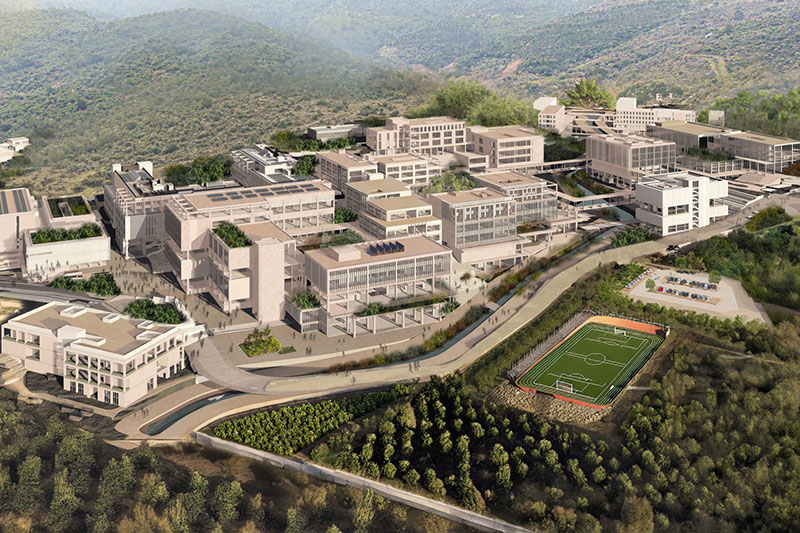
IZMIR UNIVERSITY OF ECONOMICS GÜZELBAHÇE CAMPUS
DetailsGLOBAL CAREER
As Izmir University of Economics transforms into a world-class university, it also raises successful young people with global competence.
More..CONTRIBUTION TO SCIENCE
Izmir University of Economics produces qualified knowledge and competent technologies.
More..VALUING PEOPLE
Izmir University of Economics sees producing social benefit as its reason for existence.
More..
You are one step ahead with your graduate education at Izmir University of Economics.